









KGSP Students represent KAUST at SC25
This November, a group of KGSP students attended The International Conference for High Performance Computing, Networking, Storage, and Analysis (known as SC25), one of the world’s premier conferences focused on supercomputing. The annual conference serves as a nexus for sharing best practices in areas of high-performance computing such as algorithms, applications, architectures and networks, cloud and distributed computing, data analytics, visualization, and more.
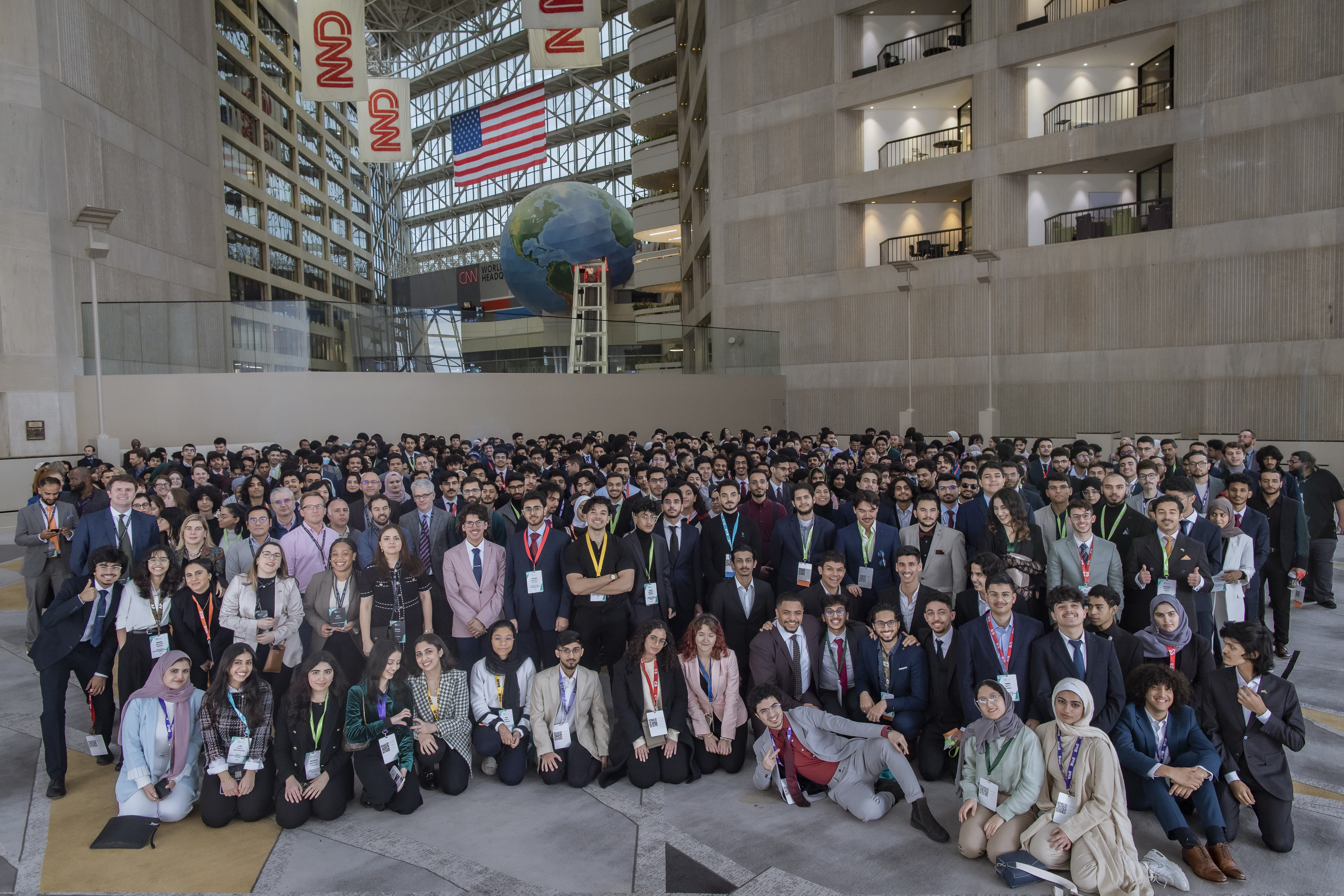
While at SC25, Ali Bo Khamseen (Senior, University of Texas), Shaden Almodhy (Junior, University of Illinois), Sulaiman Alkadi (Junior, Caltech), and Turki Almejhed (Junior, New York University) had the opportunity to represent KAUST at an exhibition booth. The SC25 conference was an exciting moment for KAUST, which announced it is the new home for Shaheen III, the Middle East’s newest and fastest supercomputer.

Turki spoke with the KGSP about his experience at SC25 and offered some reflections on how he was able to connect with researchers and industry professionals, engage with the broader supercomputing community, and appreciate firsthand systems that were shaped by years of analysis and refinement.
What was the conference like?
Turki: SC’25 was an immersion into the forefront of high-performance computing, an ecosystem where industry, academia, and national labs openly exchange ideas, debate architectures, and showcase breakthroughs. It made it clear how fast the field is evolving and how great collaboration drives progress. It was surprising to see how a lot of the companies work with each other either directly or indirectly. Being there gave me a concrete sense of how supercomputing underpins everything from climate modeling to AI scalability.
What was it like representing KAUST at the booth?
Turki: Representing KAUST was a great experience and an honor being a recipient of their scholarship program. Hearing how consistently Shaheen III ranks among the world’s top systems and seeing how respected KAUST’s research output is globally and regionally reinforced the scale and ambition of the institution I’m part of. Interacting with visitors gave me a deeper appreciation of KAUST’s diverse research culture and how our faculty and students contribute to important global problems in STEM.
What was the most valuable thing you learned?
Turki: What stood out wasn’t just the intricacy of the systems, the custom architectures, memory hierarchies, and massive datasets, but the realization of how they become possible in the first place. Everything on display was the product of years of iteration, experimentation, and relentless collaboration across teams and institutions. Seeing that up close made me realize that supercomputing isn’t about one breakthrough, It’s about the collective discipline to refine, test, and rebuild until the impossible becomes routine.

How did the conference influence your understanding of the field?
Turki: Before the conference, supercomputing was something I understood at a distance. SC’25 helped me connect the “why, how, and where” of HPC, how it differs from other computing domains, who operates it, and why it’s critical infrastructure for scientific progress. It didn’t push me toward a career in HPC, but it clarified its role within the broader tech ecosystem and helped me understand where my own interests do and don’t lie.
What would you say to a student considering representing KAUST at a conference booth?
Turki: Go in with optimism and curiosity. You don’t need to be an expert to benefit, but you do need the willingness to ask questions, meet people, and push beyond what you already know. Even if HPC isn’t your future path, exposure to how top researchers and engineers think will sharpen your perspective and help you understand the bigger picture of the field. At minimum, you walk away with clarity and at best, with inspiration.
The KGSP team commends the undergraduate students who represented KAUST at SC25 and contributed to its presence on a global stage. Experiences like this highlight the value of conference participation in helping students gain perspective, build confidence, and better understand the broader research landscape they are part of or are developing a growing interest in.


STUDENT PROFILE
KGSP students represent the Kingdom of Saudi Arabia’s future scientists, engineers, entrepreneurs, and thought-leaders. As both individuals and as a community, they reflect the KAUST mission of driving scientific discovery through excellence in education and cutting-edge research, and share a commitment to fostering innovation, economic development, and social prosperity throughout the Kingdom and the world.

ADMISSIONS REQUIREMENTS
Selection to the KGSP is extremely competitive, and currently by invitation only. Successful applicants are Saudi Arabian students in their final year of high school who demonstrate impressive academic credentials within STEM fields, meaningful extra-curricular achievements, and who share the KAUST ethos of continuous discovery. Learn more here.

KGSP ADMINISTRATION
The KGSP is administered by KAUST Academy under the leadership of Dr. Sultan Al-Barakati. KAUST Academy is mandated by KAUST to support the acceleration of Saudi Arabia's knowledge-based economy by providing world class training programs in emerging technologies aligned with Vision 2030. KAUST Academy crafts these unique learning interventions by exporting the intellectual DNA acquired by KAUST for the benefit of the entire Kingdom.
—King Abdullah bin Abdulaziz al Saud
1924 – 2015